T
Peau
N
Ganglions
M
Métastases
B
Sang
Examens
NFS, LDH
-
TDM TAP
-
Clonalité T sanguine
-
CMF (cytométrie en flux)
-
Développé à des fins pédagogiques, ne se substitue pas à une décision médicale individualisée en RCP.
TNMB staging for mycosis fungoides and Sézary syndrome.
| Skin | |
| T1 | Limited patches, papules, and/or plaques covering <10% of the skin surface. May further stratify into T1a (patch only) versus T1b (plaque +/- patch). |
| T2 | Patches, papules, or plaques covering ≥10% of the skin surface. May further stratify into T2a (patch only) versus T2b (plaque +/- patch). |
| T3 | One or more tumours (≥1-cm diameter) |
| T4 | Confluence of erythema covering ≥80% body surface area |
| Node | |
| N0 | No clinically abnormal peripheral lymph nodes; biopsy not required |
| N1 | Clinically abnormal peripheral lymph nodes; histopathology Dutch grade 1 or National Cancer Institute (NCI) LN0–2 N1a Clone negative N1b Clone positive |
| N2 | Clinically abnormal peripheral lymph nodes; histopathology Dutch grade 2 or NCI LN3 N2a Clone negative N2b Clone positive |
| N3 | Clinically abnormal peripheral lymph nodes; histopathology Dutch grades 3–4 or NCI LN4; clone positive or negative |
| Nx | Clinically abnormal peripheral lymph nodes; no histologic confirmation |
| Visceral | |
| M0 | No visceral organ involvement |
| M1 | Visceral involvement (must have pathology confirmation and organ involved should be specified) |
| Blood* | |
| B0 | Absence of significant blood involvement: ≤5% of peripheral blood lymphocytes are atypical (Sézary) cells |
| B0a | Clone negative |
| B0b | Clone positive |
| B1 | Low blood tumour burden: >5% of peripheral blood lymphocytes are atypical (Sézary) cells but does not meet the criteria of B2 |
| B1a | Clone negative |
| B1b | Clone positive |
| B2 | High blood tumour burden: ≥1000/μl Sézary cells with positive clone |
SS is staged as T4 N2/3/x M0 B2.
* Blood staging for MF/SS is further defined as B0 = <250/ml of CD4+/CD26- or CD4+/CD7- cells, B1 = does not meet criteria for B0 or B2, and B2 = ≥1000/ml of CD4+/CD26- or CD4+/CD7- cells or other aberrant population of lymphocytes identified by flow cytometry [3], [240].
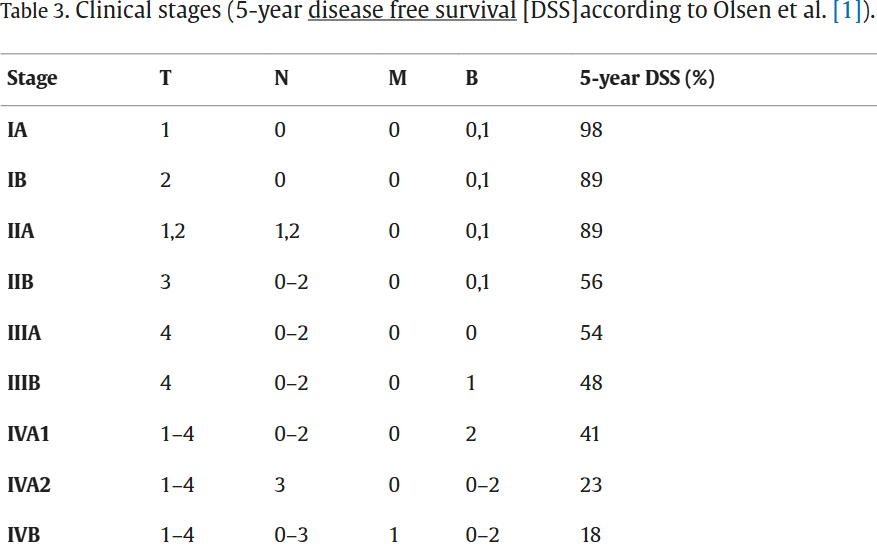
Cet outil interactif détermine le stade clinique ISCL/EORTC d'un mycosis fongoïde ou d'un syndrome de Sézary à partir de l'atteinte cutanée (T), ganglionnaire (N), viscérale (M) et sanguine (B). Il affiche la survie sans maladie (DSS) à 5 ans selon Olsen et al. et propose le bilan d'examens complémentaires adapté.
Développé à des fins pédagogiques pour les dermatologues et oncologues. Ne se substitue pas à une décision médicale individualisée en RCP.